Global healthcare access is still usually framed as a capacity problem. Not enough hospitals. Not enough doctors. Not enough funding. Those constraints are real, but they no longer explain most failures in care delivery.
The deeper issue is coordination.
In many countries, treatment exists somewhere inside the system. What breaks is timing. A diagnosis comes late. A referral never resolves. A patient disappears between primary care and specialty care. Mortality often follows administrative delay rather than clinical impossibility.
Health technology is beginning to change that. Healthcare is shifting from place-based delivery to network-based delivery. Once that shift happens, access stops being a geography question. It becomes an operational one.
The World Health Organization estimates 4.5 billion people still lack full coverage of essential health services, and roughly 2 billion people experience financial hardship due to out-of-pocket medical spending.
The access problem becomes clearer when workforce capacity is considered. The issue is not only funding or infrastructure. The system lacks enough clinicians to operate the traditional model of care.
The McKinsey Health Institute estimates a shortage of at least 10 million healthcare workers by 2030, and importantly notes that expanding training pipelines alone will not solve the problem.
From Local Clinics to Networked Care Delivery
Telemedicine did not expand because the technology improved. It expanded because the referral model was failing.
For decades, primary care in large parts of the world functioned as a handoff point rather than a treatment setting. A patient visits a clinic, sees a generalist, and receives a referral to a distant hospital.
Travel costs, missed work, and waiting lists intervene. The patient never reaches the specialist. Healthcare systems record this as non-compliance. Clinically, it is an untreated disease.
During COVID-19, telehealth adoption surged out of necessity. What surprised policymakers afterward was not the spike. It was the stabilization.
McKinsey’s 2024 digital health analysis shows telehealth remaining roughly three to four times pre-pandemic levels in the United States, particularly in behavioral health and chronic disease management. Internationally, the impact is larger.
That changes the structure of access. A clinic without a doctor is no longer a non-functional clinic. Clinicians understandably raise quality concerns. Some conditions require physical examination. The distinction matters. Video visits alone improve convenience. Data-supported telemedicine improves access.
Expanding Diagnostic Capacity at Scale
Healthcare debates frequently focus on treatment availability. In reality, diagnostics is the decisive barrier.
The Lancet Commission on Diagnostics estimated in its 2023 update that nearly half of the global population lacks adequate access to basic diagnostic services. Without diagnostics, medicine becomes educated guessing.
Health technology is reducing this constraint faster than most drug innovations.
Portable ultrasound devices now operate in rural clinics across parts of Africa and South Asia. Community health workers can identify high-risk pregnancies locally and escalate only necessary cases. Maternal mortality reductions in several programs followed earlier detection rather than new treatments.
Tuberculosis screening offers another example. Radiologist shortages historically limited chest X-ray interpretation. In 2024, the World Health Organization expanded guidance supporting computer-aided detection software for TB screening in high-burden regions. Software triages images and flags suspicious findings for physician review.
The impact is on operational capacity. Radiologists review fewer normal images and more actionable ones. Screening programs scale without proportional workforce expansion.
There are risks. False positives increase follow-up workload. False negatives remain clinically serious. But in many areas, the alternative was no screening at all.
In practice, the first specialist a patient encounters is sometimes software. Not by design preference, but by workforce necessity.
Continuous Care Instead of Intermittent Encounters
Access problems do not end after diagnosis. Chronic disease management exposes the structural weakness of traditional care delivery.
Healthcare systems operate episodically. Chronic disease does not.
The World Health Organization reports that non-communicable diseases now account for about 75% of global deaths. Most are manageable with consistent monitoring, and dangerous when follow-up is inconsistent.
Remote patient monitoring is beginning to align care with disease behavior.
Connected blood pressure cuffs, glucometers, and cardiac wearables transmit real-time data to care teams. Clinical workflows change. Providers intervene based on physiological signals rather than appointment schedules.
Patients experience improved continuity. Clinicians experience increased data flow. Health systems must create monitoring teams supported by triage algorithms.
Access expands. Operational complexity increases. Technology does not reduce labor. It redistributes it.
What WHO Guidance Signals to Policymakers and Providers
The World Health Organization has adopted a supportive but cautious stance on digital health.
Its recent guidance emphasizes integration with primary care systems. Digital platforms operating outside formal clinical pathways often increase engagement without improving outcomes. Fragmentation becomes a risk.
WHO also stresses sequencing. Many digital tools are deployed before sufficient clinical validation, particularly in low-resource settings. When results disappoint, trust in digital care declines broadly, not just in the specific tool.
Equity remains a central concern. Digital care can unintentionally exclude populations lacking connectivity, device access, or digital literacy. Technology can narrow gaps or widen them depending on implementation.
The pattern is consistent. Digital health works best when embedded within public health infrastructure rather than positioned as a consumer service layer.
This is not a technical limitation. It is an operational one.
Operational Lessons Emerging From Health Tech Deployments
Field implementation is revealing conclusions rarely highlighted in industry narratives.
Task redistribution matters more than device sophistication. Mortality improvements in several regions followed, enabling trained community workers to perform screenings previously restricted to physicians. The technology enabled the change. The workflow produced the outcome.
Artificial intelligence is currently delivering more value operationally than diagnostically. Hospitals are using predictive models for admissions forecasting, staffing allocation, and bed management. Emergency department wait times have improved in some systems because patient flow improved.
Interoperability remains the dominant barrier. HIMSS 2024 surveys show health system leaders identifying data exchange limitations as the primary obstacle to scaling digital health programs. A device or teleconsultation has limited value if its data never reaches the clinician’s workflow.
Adoption ultimately depends on clinician trust. Providers accept assistance. They resist automation that removes judgment authority. Transparent decision support gains traction faster than opaque recommendations, even when accuracy differs marginally.
Technologies that are Expanding Healthcare Access
The most important health technologies are not the ones attracting consumer attention. They are the ones removing friction inside care pathways.
In many cases, patients never realize technology intervened. They just reach treatment earlier.
Below are the categories actually changing access, along with where they are working in real systems.
1. AI-Assisted Triage and Clinical Decision Support
Hospitals are discovering that the first scalability constraint is triage, not treatment. Emergency departments, primary care lines, and telehealth centers are overwhelmed not because every patient is critically ill, but because every patient requires evaluation.
AI triage systems are now being used to prioritize risk before a clinician encounters it.
- UK primary care systems use symptom-assessment platforms that stratify urgency before GP review.
- U.S. health systems deploy predictive deterioration models that alert staff to sepsis or respiratory decline hours earlier.
- WHO-endorsed TB screening tools analyze chest X-rays and flag suspected cases for physician review.
The practical effect is capacity multiplication. A physician spends time on higher-risk patients while low-risk cases are safely delayed or routed to lower-acuity care. Access improves not because more doctors exist, but because physician time is used differently.
Trade-off: clinicians worry about automation bias. If staff trust triage scores too strongly, rare presentations can be missed. Governance becomes as important as the algorithm.
2. Portable and Point-of-Care Diagnostics
This is arguably the most important shift in global healthcare access.
Historically, diagnosis required a laboratory or imaging center. Today, it increasingly requires a healthtech stack.
- Handheld ultrasound devices are used by community health workers for pregnancy screening in rural settings.
- Rapid molecular tests for tuberculosis and infectious disease detection in local clinics.
- Smartphone-based retinal imaging for diabetic eye disease screening.
- Point-of-care blood analyzers are used in pharmacies and primary clinics.
The operational change is profound. Patients no longer need to reach hospitals to confirm illness. Instead, hospitals receive patients whose conditions are already identified.
This reduces late-stage presentation, one of the biggest contributors to avoidable mortality globally.
Early detection increases referral volume. Health systems must absorb that downstream demand or waiting lists simply shift location.
3. Remote Patient Monitoring and Virtual Wards
Healthcare historically begins when a patient schedules an appointment. Remote monitoring reverses that relationship. Care begins when physiology changes.
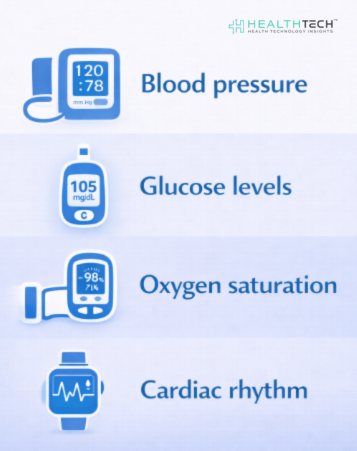
Connected devices now transmit:
- Blood pressure
- Glucose levels
- Oxygen saturation
- Cardiac rhythm
Health systems in the UK, U.S., and parts of Europe operate “hospital-at-home” programs where clinicians supervise acute patients remotely, intervening when readings worsen rather than waiting for emergency admission.
The benefit is not convenience. It is prevention. Many admissions occur because deterioration is detected too late.
These programs often increase staffing needs in monitoring centers. They prevent hospital crowding but require new clinical workflows and reimbursement models.
4. Tele-Specialty Networks
Specialist access is one of the largest global inequalities. Rural populations often have primary care but no oncology, neurology, or psychiatry coverage.
Tele-specialty consultation networks address this directly.
Examples:
- Tele-stroke programs allow neurologists to guide treatment decisions in remote emergency rooms
- Tele-dermatology systems, where images are reviewed asynchronously by specialists
- Remote psychiatry consultations for underserved regions
- ICU tele-monitoring centers supervising multiple hospitals simultaneously
These systems do not replace specialists. They distribute them.
A single neurologist can now cover multiple hospitals overnight. A rural emergency department can administer time-sensitive stroke treatment because expertise is available immediately.
The measurable outcome is time. And in stroke, time directly correlates with disability.
5. Interoperable Health Records and Data Exchange
This category is the least visible to patients and possibly the most important.
Many access failures are administrative. Patients repeat tests because records are unavailable. Emergency clinicians lack a medication history. Follow-up never occurs because referrals cannot be tracked.
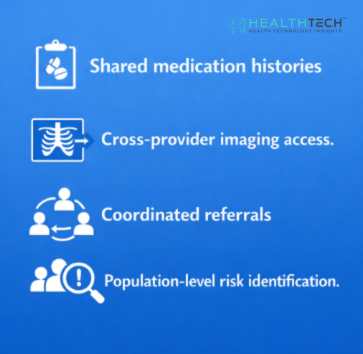
Data exchange platforms allow:
- Shared medication histories.
- Cross-provider imaging access.
- Coordinated referrals.
- Population-level risk identification.
Healthcare leaders consistently report interoperability as a major barrier to scaling digital care because technology cannot expand access if information cannot move with the patient.
The paradox is clear. The most transformative health technology is often not AI or robotics. It is information availability at the point of care.
Risks Executives Need to Plan Around
Health tech expands reach but introduces new system risks.
The International Telecommunication Union estimated in 2024 that about 2.6 billion people still lack reliable internet connectivity. Digital healthcare cannot close access gaps in regions without network access. Physical outreach remains necessary.
Cybersecurity risk is growing as well. Healthcare organizations have become frequent ransomware targets because downtime directly affects patient care. Digital records improve continuity while increasing vulnerability.
Algorithmic triage presents a clinical risk. Efficiency improves, but atypical cases may be deprioritized. Governance and human oversight remain essential.
Cost dynamics are also complex. Remote monitoring programs reduce admissions yet require monitoring infrastructure and staffing. Some systems save money. Others shift spending from inpatient care to continuous outpatient management.
Technology does not simplify healthcare economics. It reorganizes them.
The Strategic Shift Toward Distributed Healthcare
The important change is not telemedicine, AI, or wearables individually. It is a distribution.
Healthcare historically concentrated expertise in hospitals. Health technology distributes capability outward. Screening occurs in communities. Monitoring occurs at home.
Specialist input occurs remotely. Hospitals increasingly manage complex interventions rather than first contact.
Medical education is already adapting. Training programs now include telehealth communication, remote supervision, and AI decision-support literacy. Future clinicians will manage networks of patient data alongside physical examinations.
Hospitals will remain central to complex care. They will no longer be the primary gateway to healthcare.
The Shift to Distributed Healthcare
Health technology is not making healthcare futuristic. It is making healthcare reachable.
Telemedicine connects clinicians to patients who would otherwise never arrive. Portable diagnostics connect symptoms to evidence. Remote monitoring connects treatment to early intervention. AI connects limited expertise to large populations.
Yet technology alone does not improve access. Systems do. Health networks integrating digital tools into primary care workflows show measurable gains. Systems launching isolated digital services show mixed results.
Healthcare access was never purely a medical problem. It was logistical.
The sector is finally addressing logistics with the same seriousness once reserved for clinical innovation. The shift is incomplete and uneven, but directionally clear.
Care is beginning earlier, happening closer to patients, and depending less on the physical location of a hospital.
For the first time, global healthcare access is starting to function as an operational capability rather than a geographic privilege.
FAQs
1. Is health technology really expanding healthcare access, or just improving convenience?
Both. But access is the more important effect. Convenience helps patients schedule visits. Access changes whether they receive care at all. Tele-triage, remote monitoring, and distributed diagnostics allow treatment to start before a hospital encounter.
2. Why can’t health systems solve access simply by hiring more clinicians?
Chronic disease, aging populations, and mental health utilization are all increasing simultaneously. Health systems are therefore redesigning who performs early care tasks. Nurses, pharmacists, and software now handle screening and monitoring while physicians manage complexity. It is less a staffing solution than a care model shift.
3. What does AI actually do inside healthcare today?
The immediate benefit is throughput. More patients screened, fewer missed critical cases, and earlier intervention. The limitation is oversight. Automation bias is a real clinical risk if governance is weak.
4. Does telehealth lower the quality of care?
It performs well for follow-ups, behavioral health, medication management, and chronic disease monitoring. It performs poorly for conditions requiring physical examination or complex diagnostics. The mistake is treating telehealth as a replacement for in-person care. It is a triage and continuity tool. Used correctly, it improves outcomes.
5. What is the real barrier preventing digital health from scaling in the U.S.?
Health systems operate on fragmented records, incompatible platforms, and reimbursement rules designed for physical visits. Without reliable data exchange, remote monitoring data cannot inform treatment decisions, and virtual referrals stall. The problem is operational infrastructure, not software capability.
Dive deeper into the future of healthcare. Keep reading on Health Technology Insights.
To participate in our interviews, please write to our HealthTech Media Room at info@intentamplify.com