Healthcare organizations are investing in digital transformation at scale. What was once a supplemental communication channel, webinars have become a strategic engine for enterprise learning, market influence, and ecosystem engagement.
The reason is simple: the same technologies reshaping care delivery are now reshaping how knowledge is shared, internalized, and operationalized across networks of clinicians, partners, and decision-makers.
Healthcare webinars are no longer tactical plays. They represent a convergence of marketing strategy, professional learning infrastructure, and digital health adoption.
That convergence matters because healthtech leaders are being asked to justify spend against tangible outcomes in productivity, patient satisfaction, and growth. To do that effectively, leaders need to understand not just that webinars are scaling, but why health technology is amplifying reach, and what that means for enterprise performance.
The Strategic Shift in Healthcare Webinars
Across sectors, virtual events have become foundational to enterprise engagement models. The global virtual events market approached USD 98 billion in 2024 and is expected to sustain robust growth through 2030 as organisations seek scalable, remote-first engagement platforms.
“Virtual events are no longer a backup plan; they’re a strategic growth engine for organisations seeking impact, pipeline, and community in a digital age,” says the Airmeet strategic guide on virtual events, underscoring how enterprises are embedding digital formats into long-term engagement and growth strategies.
For leaders looking at long-term strategy, these are not noise metrics. Since they signal the maturation of digital channels within core operational models.
What Health Tech Means for Webinar Marketing Outcomes
Health technology has expanded the relevance of webinars across the enterprise, transforming them from one-off communications into infrastructure supporting learning, adoption, and decision intelligence.
1. Clinical Education and Rapid Knowledge Dissemination
Healthcare organizations are increasingly using webinars to deliver continuing education and urgent clinical updates at scale. According to Livestorm’s 2024 data, healthcare entities hosted an average of 23 webinars per year, significantly above the industry average, reflecting the role of digital events in ongoing professional development.
This trend isn’t incidental; higher webinar frequency aligns with sector needs for rapid dissemination of practice-critical updates.
With digital delivery, organizations avoid the cost and clinical downtime associated with in-person seminars, while rapid sharing of new evidence or protocol changes accelerates compliance and reduces risk.
2. Adoption Infrastructure for Complex Technologies
One of the persistent challenges in health tech deployments, whether interoperable EHR upgrades, AI decision support tools, or remote monitoring platforms, is clinician adoption. Webinars help bridge the gap between purchase and meaningful use.
When integrated with analytics and CRM systems, they generate data on who attended, how deeply they engaged, and where learning gaps remain.
This use case flips the traditional marketing logic on its head: webinars become adoption infrastructure rather than promotional touchpoints. Instead of simply broadcasting product features, teams can embed workflows, technical deep dives, and live Q&A with clinical experts.
That approach mirrors the broader emphasis in health systems on digital channels that improve access to timely, actionable information, which underpins frameworks like the WHO’s digital health strategy to strengthen health systems through appropriate use of digital tools.
3. Market Development and Trust Building in High-Trust Environments
Healthcare procurement and clinical recommendation loops are inherently high-trust. Buyers don’t decide on a brand based on a slick website; they seek evidence, peer validation, and relevance. Strategic webinar programs sit at that intersection. They provide platforms for expert panels, scientific discussions, regulatory interpretations, and real-world use cases.
However, the numbers warn against complacency. Although healthcare organizations are increasing webinar frequency, attendance rates have edged lower, from around 51% in 2023 to 48% in 2024, and engagement durations remain modest relative to session length.
Healthcare leaders should interpret this not as a failure of webinars per se, but as an indicator of signal dilution when volume outpaces relevance.
Webinars become trust accelerators only when content reflects deep domain credibility and aligns with strategic pain points, quality measures, clinical workflow challenges, regulatory landscape changes, not just scattershot topics.
4. Pipeline Intelligence and Customer Insight Signals
One of the least-leveraged use cases for webinar programs is their potential to generate strategic intelligence. Modern webinar platforms offer behavior signals: completion rates, topic preferences, interactive feature usage, and repeat attendance patterns.
When linked to CRM and account planning workflows, these signals become a form of intent data that can inform sales strategies and product roadmaps.
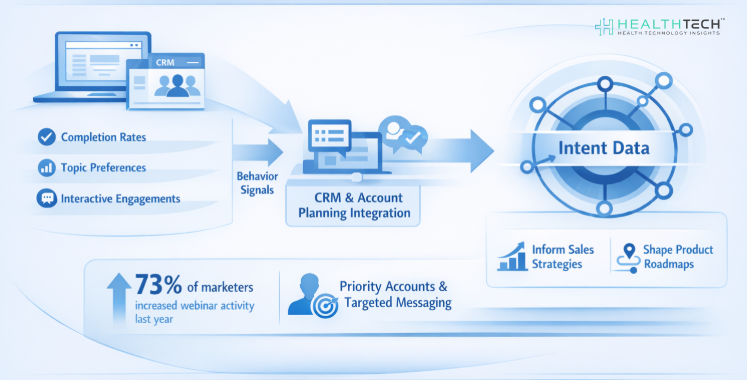
This isn’t theoretical. Marketing research across thousands of organizations shows that webinars remain a core engagement channel and that most marketers increase webinar activity year-over-year, highlighting their importance for lead generation and thought leadership.
However, the real enterprise payoff comes when these interactions feed into broader customer strategies, prioritizing accounts with sustained engagement or refining product messaging based on observed interests.
Executive Trade-offs to Acknowledge
This expanded value portfolio comes with trade-offs that matter to boards and CEOs:
Attention vs. Volume
More webinars won’t deliver more impact if topics are generic. Healthcare audiences are time-constrained; executive teams must balance output with strategic prioritization.
Data Insights vs. Privacy Governance
Advanced engagement analytics can illuminate intent, but healthcare organizations operate in regulated environments where data privacy and security must be baked into every measurement strategy.
On-Demand Reach vs. Live Interaction
On-demand recordings extend accessibility, but live sessions drive real-time dialogue that often fuels adoption and trust. Leaders must choose formats based on goals: reach or influence.
Health Tech Insights Analysis
The common thread across these use cases is leverage. Not more content, but more outcomes per unit of effort. Personalization requires stronger governance. Always-on digital engagement risks fatigue. Over automation can erode the human credibility that healthcare audiences expect.
So the strategic posture has to be deliberate. Fewer, higher-value programs tied to specific enterprise objectives: protocol adoption, product uptake, market entry, or account expansion. Anything else becomes noise. Health technology has effectively turned webinars into operational tools. Leaders who treat them as such will extract measurable advantage.
FAQs
1. How can healthcare webinars drive measurable business outcomes beyond awareness?
Healthcare webinars generate actionable insights, including attendance quality, topic engagement, and repeat participation. When integrated with CRM and sales workflows, these signals inform account prioritization, shorten sales cycles, and support data-backed product and messaging decisions.
2. What role does health technology play in scaling healthcare education and engagement?
Digital health tools enable secure streaming, analytics, personalization, and on-demand access, allowing organizations to educate dispersed clinicians and stakeholders quickly. This reduces training costs, accelerates protocol adoption, and improves consistency across systems.
3. Are webinars still effective for healthcare marketing and demand generation in the U.S.?
Yes. Webinars remain a core B2B healthcare engagement channel because they combine thought leadership, peer credibility, and interactive dialogue. When aligned with clinical or operational priorities, they consistently deliver qualified leads and deeper trust than passive content formats.
4. How do webinar analytics translate into sales and product strategy insights?
Behavioral metrics, such as completion rates, questions asked, and session preferences, serve as intent data. These insights highlight high-interest accounts, unmet needs, and feature gaps, helping teams refine roadmaps and focus sales resources where conversion likelihood is highest.
5. What’s the biggest mistake healthcare organizations make with webinar programs?
Overproducing events without strategic alignment. High volume doesn’t equal impact. The most effective programs focus on fewer, high-value sessions tied directly to clinical adoption, enterprise priorities, or targeted account growth.
Dive deeper into the future of healthcare.
Keep reading on Health Technology Insights.
To participate in our interviews, please write to our HealthTech Media Room at info@intentamplify.com