Healthcare webinars have not survived by being entertaining. They have survived by being useful. The modern healthtech webinar has become one of the few digital formats that senior healthcare leaders still engage with willingly. Not because they enjoy them, but because these sessions provide a controlled space to interrogate complexity.
By 2026, the role of the healthcare webinar is narrower but more consequential. It is no longer an entry point. It is a checkpoint. A moment where assumptions get challenged, and decisions get pressure-tested before they harden inside organizations. That shift changes everything about how webinars should be designed, staffed, and evaluated.
Webinars Now Function as Decision Validation
Education still happens in webinars. But it is rarely the primary objective for senior healthcare audiences. What leaders are actually looking for is reassurance. Or, just as often, disconfirmation.
Will this approach survive clinical reality? Will it hold up under regulatory scrutiny?
Will it introduce new risks we have not modeled yet?
Engagement data supports this behavior. Interactive elements such as Q&A, polling, and live discussion matter, not because they are engaging in themselves, but because they allow attendees to test scenarios in real time.
Participation increases when content acknowledges constraints rather than glossing over them. This is why narrative-heavy, vision-first webinars tend to underperform with experienced audiences. They answer questions no one is asking.
According to Zoom’s 2025 webinar statistics, high-performing webinars can see around 64% average engagement rates, and adding Q&A, polls, and chat can extend audience engagement significantly. That means participants are more inclined to engage when they feel the content confronts real challenges and gives them agency to interact with solutions in real time.
Operational Proximity Matters More Than Prestige
Healthcare audiences are not persuaded by titles alone. They are persuaded by proximity to consequence. Webinars led by practitioners, implementers, and clinical or security leaders who own outcomes consistently outperform those fronted by brand executives or professional speakers.
When a speaker can explain what failed. Where adoption stalled. Why a control had to be rolled back. The conversation changes. It becomes grounded. Trust follows.
This matters because healthcare buyers are structurally risk-averse. They spend much of their time reconciling the gap between how solutions are marketed and how they behave under pressure. Webinars that acknowledge this gap signal realism. Those who ignore it signal distance.
Clinical, Marketing, and Security Audiences Are Converging
One of the most common mistakes healthtech brands still make is audience segmentation that no longer reflects reality.
Clinical leaders, healthcare marketing teams, IT, and security functions increasingly sit in the same decision loops. AI adoption, remote care, patient engagement platforms, and data-driven marketing all collapse traditional boundaries. Risk now travels across functions. Webinars that isolate clinical outcomes from data governance. Or a growth strategy from security exposure. Feel incomplete.
Effective sessions bridge these perspectives deliberately. They surface tensions rather than smoothing them out. Clinical benefit versus operational burden. Speed versus auditability. Engagement versus consent. That friction is not a problem to solve. It is the context in which healthcare decisions are made.
Interactivity Helps, But Cognitive Friction Is Real
Interactive features are not inherently valuable. They are tools. Misused, they become noise. Healthcare audiences, particularly physicians and executives, have limited tolerance for performative engagement. They respond to sessions that move quickly, make a point, and then move on. Pacing matters more than polish.
Short segments. Clear shifts in perspective. Moments where the speaker stops talking and allows the audience to think. Long monologues framed as education often fail, even when the content is strong. Not because the audience disagrees, but because cognitive load builds faster in virtual environments.
Think Beyond Compliance: Emphasize Governance and Resilience
By 2026, compliance claims are assumed. HIPAA. Interoperability. Baseline security controls. None of these differentiate a healthtech brand. What differentiates is governance.
Who owns change when regulation shifts mid-cycle? How are model updates reviewed?
What happens when clinical guidance evolves faster than product roadmaps? How are audit trails preserved under operational strain?
Webinars that address these questions directly, including where answers are still incomplete, signal seriousness. Those who rely on certification language do not.
Healthcare leaders are not looking for certainty. They are looking for preparedness.
Webinars Are Asynchronous by Default
Live attendance continues to decline, and that is not a failure mode. It is a behavioral shift.
Healthcare leaders increasingly consume webinar content after the fact. In fragments. Between patient care, incident reviews, and board preparation. Often shared internally rather than watched end-to-end.
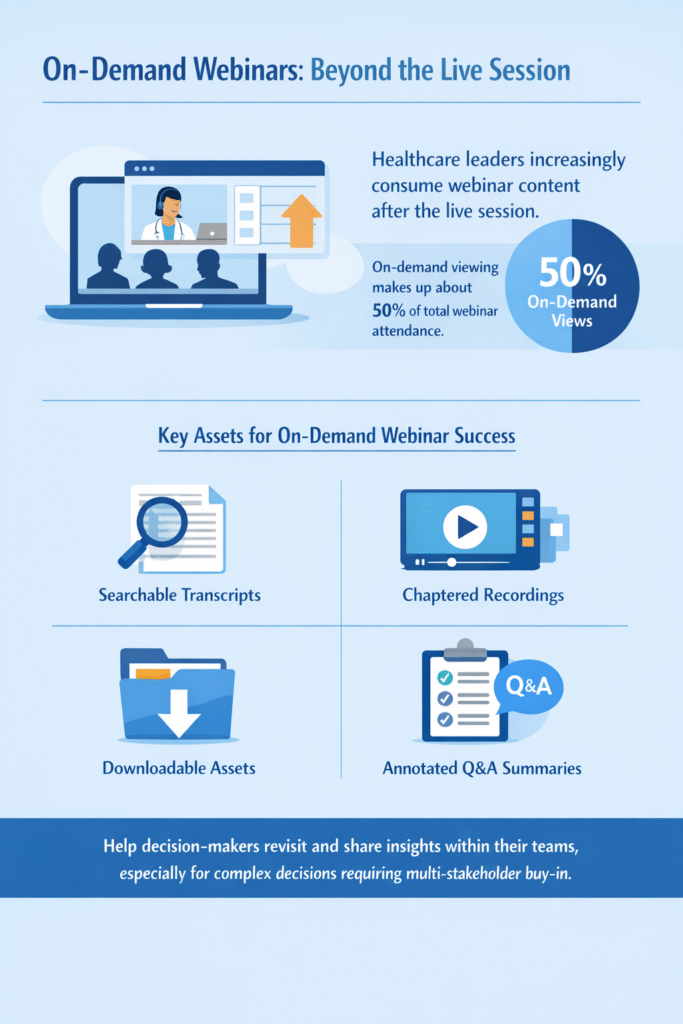
This makes post-event design as important as the live session itself.
- Searchable transcripts.
- Chaptered recordings.
- Downloadable artifacts.
- Annotated Q&A summaries.
These assets turn a webinar from a moment into a resource. They allow insights to travel across teams and support decisions that require multiple stakeholders to align over time.
HealthTech Insights Analysis
From our perspective, healthcare webinars in 2026 operate as a proxy for organizational maturity. They reveal how a brand thinks under constraint. How it handles uncertainty. Whether it understands the realities of operating inside healthcare systems shaped by AI acceleration, persistent cyber risk, and regulatory flux.
What consistently fails is performative certainty. Over-produced sessions. Linear narratives. Promise-heavy framing that avoids unresolved questions.
What resonates is restraint. Specificity. A willingness to surface trade-offs without immediately resolving them. The most effective healthtech webinars now resemble working sessions more than campaigns. They prioritize judgment over messaging, clarity over persuasion, and accountability over aspiration.
FAQs
1. How effective are webinars for healthcare decision-makers in 2026?
They remain effective when they help validate or de-risk decisions already in motion. Attendance matters less than whether the session advances internal alignment.
2. What makes a healthcare webinar credible to CMOs, CISOs, and clinical leaders?
Operational specificity. Clear articulation of trade-offs, governance implications, and real-world constraints.
3. Why are on-demand webinars more important than live attendance?
Healthcare leaders consume content asynchronously and often redistribute it internally. Post-event assets extend decision value.
4. How should HealthTech brands structure webinars for multi-stakeholder audiences?
By integrating clinical, operational, and security perspectives instead of treating them as separate conversations.
5. What mistakes do HealthTech companies still make with webinars in 2026?
Treating them as marketing broadcasts rather than decision forums. Polished certainty is often read as inexperience.
Dive deeper into the future of healthcare. Keep reading on Health Technology Insights.
To participate in our interviews, please write to our HealthTech Media Room at info@intentamplify.com