
Preventive care has historically depended on scheduled encounters. Annual physicals. Risk questionnaires. Periodic lab panels. The assumption was simple. If a problem mattered, it would eventually appear in a clinic. Sleep monitoring breaks that assumption.
Healthcare can now observe physiological instability continuously without waiting for a patient to present. Not step counts or lifestyle scoring. Autonomic regulation.
The implication is uncomfortable. A system that only evaluates patients during visits is not practicing prevention. It is documenting delayed detection.
Sleep already influences outcomes. The real question is whether healthcare organizations are willing to redesign care around a signal that appears outside the clinic.
Below are the questions healthcare leaders are attempting to answer in 2026.
What Does Sleep Technology Mean Inside Healthcare?
In clinical settings, sleep technology refers to continuous physiological monitoring during rest that produces longitudinal health signals rather than single diagnostic tests.
Traditional sleep medicine uses overnight polysomnography. Useful but episodic. One night in an artificial environment. Good for diagnosing apnea. Poor at understanding health trajectory.
Modern monitoring platforms collect recurring data at home. Heart rate variability, respiratory patterns, oxygen saturation, and sleep fragmentation.
The importance is not the sensor. It is the baseline. Preventive care depends on detecting deviation, and deviation requires repeated measurement.
Community Health Systems partnered with Cadence to deploy a system-wide remote patient monitoring infrastructure that tracks patients’ physiological data at home and allows clinicians to intervene earlier in chronic disease progression rather than waiting for hospital visits.
“Our partnership with Cadence offers powerful technology and virtual care to support patients in the prevention, monitoring, and management of chronic conditions,” said Lynn Simon, MD, President of Clinical Operations & Chief Medical Officer of Community Health Systems.
Healthcare is not using these systems to tell patients they slept poorly. It is using them to detect when a body stops regulating normally.
Why are Providers Treating Sleep as Preventive Healthcare?
Cardiac patients often show rising resting heart rate and fragmented sleep before fluid overload becomes obvious.
Patients entering depressive relapse commonly experience circadian disruption days or weeks before reporting mood symptoms.
Metabolic instability frequently follows irregular sleep timing rather than preceding it. Sleep functions less like a comfort variable and more like a system stability indicator.
Preventive healthcare depends on leading indicators. Blood tests are lagging indicators. Sleep is closer to a behavioral biomarker.
Health Technology Insights describes preventive healthcare devices: “as systems that track ongoing physiological change and allow intervention before deterioration becomes clinically visible.”
Industry reporting increasingly frames connected health devices as early-detection infrastructure rather than wellness tools.
The shift is practical. A clinician cannot intervene before deterioration if the system only measures patients during office visits.
Are Wearable Devices Reliable Enough for Medical Decisions?
Clinical sleep labs remain necessary to confirm obstructive sleep apnea or other disorders. Consumer wearables cannot replace that. The confusion comes from assuming the use case is diagnosis.
Healthcare providers are using wearables directionally. They look for change, not perfection. If a patient’s baseline heart rate variability declines for several nights and sleep becomes fragmented, the signal is meaningful even if sleep stage classification is imperfect.
As noted by Health Technology Insights, wearable devices can collect continuous biometric data that clinicians can use to identify patterns and deviations indicative of emerging health risk, enabling earlier awareness of physiological change outside the clinic.
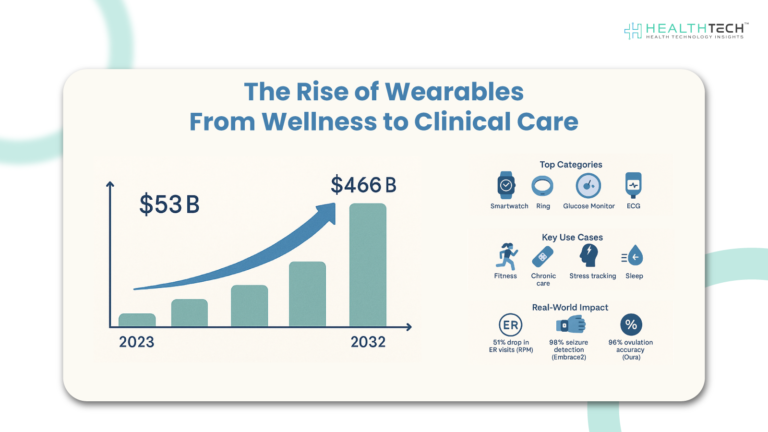
Preventive medicine does not depend on diagnostic certainty. It depends on acting before certainty exists. Waiting for confirmation is appropriate in acute care. In prevention, it is usually what makes intervention late.
There is a trade-off. High sensitivity generates false alarms. False alarms create clinical workload. Any health system deploying continuous monitoring without algorithmic filtering quickly encounters alert fatigue.
Continuous monitoring without automated triage does not scale. It transfers data burden to clinicians and quickly collapses adoption. The limiting factor is not sensors. It is a workflow capacity.
Health Technology Insights explains that Remote patient monitoring (RPM) involves the collection and transmission of physiological data from patients outside healthcare facilities, allowing clinicians to monitor trends and intervene earlier. RPM is described in industry coverage not just as a telehealth convenience, but as a means of extending clinical observation into the home.
How are Hospitals using Sleep Data in Real Workflows?
In heart failure programs, monitoring platforms flag physiological instability before patients call with shortness of breath. Nurses contact the patient, adjust diuretics, and sometimes prevent readmission.
After surgery, persistent sleep disruption often correlates with pain control problems or complications. Recovery monitoring programs use abnormal sleep patterns as a prompt to check on patients who otherwise appear stable.
In behavioral health care, sleep instability frequently precedes crisis visits. Some care coordination teams now intervene based on sleep changes rather than waiting for missed appointments. Healthcare technology adoption is now centered on operational redesign.
The Health Technology Insights industry report describes intelligent clinical systems as tools that restructure how care teams work by automating documentation, supporting clinical decisions, and integrating patient data directly into care processes rather than leaving it siloed across systems.
The value is timing. Earlier contact changes treatment intensity. When outreach happens during instability, care is an adjustment. When it happens after symptoms, care becomes rescue.
Why are Insurers and Value-based Care Organizations Interested?
Between stability and emergency admission, there is usually a detectable decline. Historically, the decline was invisible to providers. Continuous monitoring exposes it.
If a payer can support early outreach, telehealth evaluation, or medication adjustment, the cost is dramatically lower than inpatient care.
Value-based contracts reward avoided admissions. Continuous monitoring makes avoidance operational rather than aspirational.
Payers and value-based care organizations are increasingly exploring data-driven technologies that support earlier intervention and more precise risk management.
Health Technology Insights analysis highlights how artificial intelligence is reshaping the health insurance ecosystem by enabling more accurate risk stratification, predictive modeling, and dynamic care pathways that anticipate health events rather than react to them.
Adoption is being driven by payment models that penalize late intervention. Sleep monitoring fits value-based care because it allows action before the admission risk materializes.
Sleep Monitoring for Physical Health or Mental Health?
Cardiac deterioration produces measurable biomarkers, but psychiatric relapse is harder to detect early. Sleep disturbance is one of the most consistent early changes before depressive or bipolar episodes.
Continuous monitoring does not diagnose depression. It identifies instability. Care teams can check in before a crisis emerges.
The limitation is obvious. Not every bad week predicts relapse. Life events disrupt sleep. Travel disrupts sleep. Over-interpreting every variation risks medicalizing normal behavior. Under-interpreting misses preventable deterioration.
Psychiatry historically lacked early warning signals. Now it has one. The difficulty is no longer detection. It is deciding when a variation warrants outreach and when it reflects normal life.
Will This Replace Sleep Specialists or Sleep Labs?
Instead of broad screening, sleep specialists increasingly see pre-identified higher-risk patients. Continuous monitoring identifies who should be evaluated, while specialists confirm and treat conditions.
According to a survey from the American Academy of Sleep Medicine, over one-third (38%) of adults say using their phone or tablet before bed to view news and current events, or “doomscrolling,” makes them sleep slightly or significantly worse, disproportionately affecting younger adults aged 18-24 (46%).
The volume of raw data grows, but specialist attention becomes more targeted. The model resembles imaging triage in radiology, where automated analysis prioritizes cases rather than eliminating expertise.
The World Health Organization describes AI in healthcare as a clinical decision-support mechanism that helps clinicians identify higher-risk cases and focus specialist attention where it is most needed, especially in diagnostic and imaging pathways.
Continuous monitoring systems operate similarly by flagging patients who require evaluation while leaving diagnosis and treatment to physicians.
What are the Biggest Barriers to Adoption?
Clinicians already manage overwhelming data streams. Adding continuous biometrics without intelligent filtering creates more noise than value. Systems must deliver actionable signals, not nightly reports.
The other barrier is governance. Sleep data reveals behavioral patterns. Patients may accept monitoring by clinicians but resist employer or insurer access, even indirectly.
Technical limitations slow deployment. Trust determines whether deployment is accepted. Without clear boundaries on who can access behavioral data, patients disengage and programs fail regardless of accuracy.
Why is 2026 a Turning Point?
Three forces are aligned at the same time.
Remote patient monitoring reimbursement made continuous observation financially viable. Value-based care made early intervention economically important. Sensor accuracy improved enough to detect meaningful trends.
Individually, none would have shifted practice. Together, they change incentives.
Preventive healthcare is becoming continuous rather than episodic. Sleep monitoring is simply one of the first scalable inputs enabling that model.
Is Sleep Becoming a Standard Vital Sign?
Preventive healthcare was built around visits because medicine had no practical way to observe patients between visits. The annual exam became a proxy for health simply because it was measurable.
Continuous monitoring removes that limitation. Care no longer begins when symptoms appear. It begins when regulation changes.
Sleep monitoring is important because it measures physiological stability repeatedly and consistently. That changes what healthcare can act on. Instead of diagnosing disease after deterioration, systems can intervene during destabilization.
This is the real shift. Sleep technology is not expanding sleep medicine. It is quietly redefining when care starts. The organizations adopting it earliest are not trying to learn more about sleep.
They are trying to move healthcare from episodic detection to continuous management. Once a system can observe patients daily, the visit stops being the center of care and becomes one of many escalation points.
Sleep is simply the first scalable signal that makes this possible.
Health Technology Insights Analysis
Industry coverage increasingly positions remote monitoring as an extension of the clinical perimeter, not a convenience layer. What changed is not sensor capability alone.
It is the convergence of AI triage, interoperability improvements, and reimbursement pathways that make continuous observation financially defensible.
Recent Health Technology Insights reporting frames remote patient monitoring as an operational redesign lever rather than a telehealth accessory. That distinction matters.
Telehealth replicates visits virtually. Continuous monitoring eliminates the assumption that care begins with a visit at all.
There is also a clear AI layer emerging. Monitoring platforms are no longer passively collecting data. They are applying predictive modeling to stratify risk and suppress noise.
Without algorithmic triage, sleep and biometric data overwhelm clinicians. With it, they surface only instability patterns that cross defined thresholds. The technology’s value depends less on sensor fidelity and more on signal filtration.
Another consistent theme across industry analysis is economic alignment. Value-based contracts reward avoided admissions and early intervention. Sleep-derived physiological trends become actionable when financial incentives favor prevention over episodic billing.
Adoption correlates directly with payment reform. Where reimbursement remains visit-centric, monitoring remains experimental.
Behavioral data is sensitive. Sleep patterns expose lifestyle rhythms, stress cycles, and even mental health fluctuation. Health systems must define strict boundaries around payer, employer, and third-party access. Trust architecture is becoming as important as technical architecture.
The deeper shift is structural. Continuous monitoring moves healthcare from reactive documentation to active surveillance of physiological stability.
Health Technology Insights increasingly describes intelligent clinical systems as decision-support environments. Sleep monitoring fits squarely inside that reframing.
The organizations gaining advantage are not those collecting the most data. They are the ones redesigning escalation pathways around instability detection.
FAQs
1) Can sleep monitoring realistically influence clinical care, or is it still observational data?
It influences care when the system watches change, not sleep stages. Clinicians do not act because a patient had 6 hours instead of 7. They act when a stable baseline suddenly destabilizes. Rising nighttime heart rate, fragmented sleep, and altered respiratory patterns.
2) Why are health systems suddenly interested in sleep data after ignoring it for decades?
Hospitals are now financially exposed to readmissions and deterioration after discharge. Sleep monitoring gives them visibility during the period when risk actually rises, which is between visits. Without financial risk, this data would still be sitting in consumer apps.
3) Are wearables accurate enough for medical use?
Accurate enough for trend detection, not for diagnosis. That distinction matters. A single night of reading from a wearable is weak clinical evidence. Ninety nights showing the same patient drifting away from their baseline is strong operational evidence.
4) Does continuous monitoring actually reduce hospitalizations?
Remote monitoring programs fail when data arrives, but nobody is responsible for acting on it. They succeed when nurses or care coordinators intervene early.
5) Is sleep becoming a new vital sign?
Healthcare was designed around episodic measurement because that was all medicine could capture. Continuous monitoring breaks that design assumption. The real shift is earlier intervention, which quietly moves care away from diagnosis and toward management of instability.
Dive deeper into the future of healthcare. Keep reading on Health Technology Insights.
To participate in our interviews, please write to our HealthTech Media Room at info@intentamplify.com


