GLP-1 therapies have experienced one of the fastest adoption cycles in modern medicine. A therapy class that began as a fairly conventional diabetes treatment is now functioning as something closer to a metabolic platform.
Diabetes control. Obesity treatment. Cardiovascular risk reduction. Increasingly, a long list of experimental applications is still under study.
That scale matters. Since once a therapy moves from specialist clinics to mass-market prescribing, the center of gravity shifts away from clinical trials and toward post-market surveillance.
The FDA’s recent warning letter to Novo Nordisk sits exactly in that uncomfortable transition.
The agency found that the manufacturer failed to properly report several serious adverse events linked to GLP-1 medicines, including deaths and a suicide, within the required regulatory timeline for post-marketing safety reporting.
The FDA did not conclude the drugs caused those events. The violation was the reporting failure itself.
However, the regulatory “procedural” problems are rarely only procedural in the pharmaceutical world.
A Pharmacovigilance System Built for Slower Drugs
Drug safety monitoring was built around a slower innovation cycle. A drug would reach the market gradually, often through specialist prescribing networks, and adverse events would accumulate through physician reports and hospital systems.
GLP-1 drugs have broken that model.
Semaglutide, the active ingredient in Ozempic and Wegovy, is now prescribed broadly for type 2 diabetes and chronic weight management, and has generated tens of millions of prescriptions in the United States alone.
Prescribing is no longer confined to endocrinology clinics. Telehealth platforms, subscription weight-management services, and retail health providers are all now part of the distribution network.
That fragmentation changes how safety data flows.
Adverse events reported through a telemedicine platform do not necessarily enter the same clinical documentation pipeline as hospital-reported complications. Patient-reported symptoms inside digital health apps may never reach formal pharmacovigilance channels at all.
The system was designed for physician-mediated reporting. It now operates in a healthcare economy where physicians are not always the primary interface.
The FDA inspection suggests the friction is already showing. Investigators concluded Novo Nordisk had internal procedures that allowed adverse events to be cancelled if staff believed they were unrelated to the drug.
That practice contradicts FDA requirements, which mandate reporting serious events regardless of suspected causality.
That may sound like bureaucratic technicality. It isn’t. The entire safety surveillance system depends on over-reporting first and interpretation later.
The GLP-1 Safety Picture Is Still Evolving
None of this means GLP-1 drugs are fundamentally unsafe. In fact, most physicians would argue the opposite. For many patients with severe obesity or uncontrolled diabetes, these therapies deliver meaningful health improvements.
But their safety profile is still developing in real-world populations.
Even in the short term, the side-effect discussion has become more complex. Gastrointestinal issues remain the most common complication, but new research is probing less obvious signals.
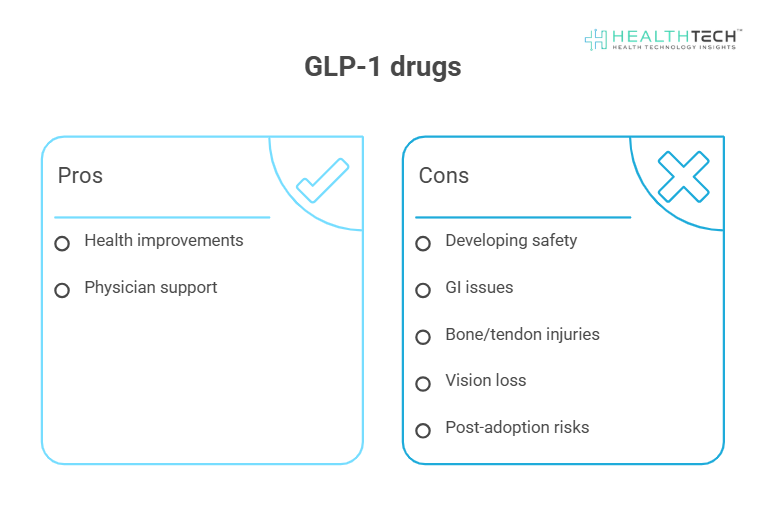
One recent analysis linked GLP-1 use to elevated risks of bone and tendon injuries over several years of treatment, although the findings remain preliminary.
Another line of research has examined rare cases of sudden vision loss associated with semaglutide-based weight-loss drugs, a signal that requires more rigorous investigation before conclusions can be drawn.
These signals do not automatically invalidate the drugs’ benefits. However, they illustrate a broader truth about modern therapeutics. The clinical trial phase is no longer where the full safety profile emerges.
That happens after mass adoption.
The Real Structural Problem
The FDA warning lands at an awkward moment for regulators.
On one hand, demand for GLP-1 drugs continues to surge. The category has effectively become the pharmaceutical industry’s most valuable metabolic franchise.
On the other hand, the surveillance infrastructure used to monitor those drugs is still evolving.
The FDA recently launched a unified adverse-event monitoring platform intended to consolidate fragmented safety databases and allow real-time access to reported incidents.
“Consolidating the FDA’s adverse event systems and converting to real-time publication was challenging, but made possible by a highly aggressive schedule,” said the Chief AI Officer, Jeremy Walsh.
The upgrade alone reveals the underlying challenge. The agency has been processing roughly six million adverse-event reports annually under older systems that were widely criticized as fragmented and slow.
In other words, the regulatory apparatus is still modernizing at the exact moment the pharmaceutical pipeline is accelerating.
Those timelines rarely align.
A Bigger Question for Health Technology
The immediate story focuses on Novo Nordisk’s reporting procedures. However, the broader issue extends beyond one company.
Drug safety surveillance is still largely manual.
Manufacturers collect reports. Physicians submit forms. Regulators review aggregated case files months or years after patterns emerge.
That structure made sense when drug adoption curves were gradual.
It looks increasingly outdated in a world where therapies can reach millions of patients within a few years of approval.
There is a reason digital health companies are pushing aggressively into real-world evidence analytics. Large-scale electronic health record (EHR) datasets, pharmacy networks, and patient-generated health data offer the possibility of detecting safety signals earlier than traditional reporting systems.
But those systems remain fragmented as well. Pharmaceutical companies, health systems, regulators, and digital health platforms rarely share interoperable data infrastructure.
Which leaves the pharmacovigilance ecosystem in a strange place. Technologically advanced medicine operating on surveillance systems that still resemble early-2000s data architecture.
The Trade-Off No One Likes to Admit
The GLP-1 story captures a familiar tension in modern medicine.
Patients benefit from faster therapeutic innovation. Regulators want rapid access to breakthrough treatments. Pharmaceutical companies compete to scale adoption quickly.
All of that works. Until safety monitoring falls behind.
The FDA warning letter does not prove GLP-1 drugs are dangerous. The agency itself has said the investigation does not establish a causal link between the reported deaths and the medications.
However, this exposes a deeper structural contradiction.
The pharmaceutical industry has learned how to scale therapies extremely quickly. The systems designed to monitor those therapies are still catching up.
For GLP-1 drugs, that tension will likely define the next phase of the market. Not just new formulations or expanded indications.
Something more mundane, and more consequential.
FAQs
1. What prompted the FDA warning to Novo Nordisk regarding GLP-1 drugs?
The FDA issued a warning after finding that Novo Nordisk failed to report several serious adverse events linked to its GLP-1 medications within the required regulatory timeline. The issue relates to pharmacovigilance compliance rather than confirmed drug safety failures.
2. Does the FDA warning indicate that GLP-1 drugs like semaglutide are unsafe?
No. The FDA has not concluded that the reported incidents were caused by the drugs. The warning focuses on delayed or incomplete adverse-event reporting, which regulators rely on to monitor drug safety after approval.
3. Why are GLP-1 therapies facing increased regulatory scrutiny now?
GLP-1 drugs are being prescribed at an unprecedented scale for diabetes and obesity. As millions of patients begin long-term treatment, regulators are paying closer attention to rare or delayed side effects that only appear in large real-world populations.
4. How could the FDA warning affect pharmaceutical companies developing metabolic therapies?
The warning signals that regulators expect stronger pharmacovigilance systems as blockbuster therapies scale. Drug makers may face greater pressure to improve adverse-event reporting infrastructure and real-time safety monitoring.
5. What role could health technology play in improving drug safety monitoring?
Health technology platforms using electronic health records, real-world evidence networks, and AI-driven analytics may help identify safety signals faster than traditional reporting systems, potentially strengthening post-market drug surveillance.
Dive deeper into the future of healthcare. Keep reading on Health Technology Insights.
To participate in our interviews, please write to our HealthTech Media Room at info@intentamplify.com